

Summary
The best running recovery isn't expensive, and it isn't complicated. According to physical therapist and ultra runner Danny Foerster, refueling well, sleeping enough, and staying consistent will do more for you than any gadget on the market. Here are his five tips for recovering after a long run so you can get back out there and do it again next week.
When you're training for a 200-miler, the long run isn't always the hard part. Sometimes, the hard part is recovering well enough to wake up and chase the next one. A 50-mile training day only pays off if your body can absorb it, and that comes down to what you do in the hours after you stop moving.
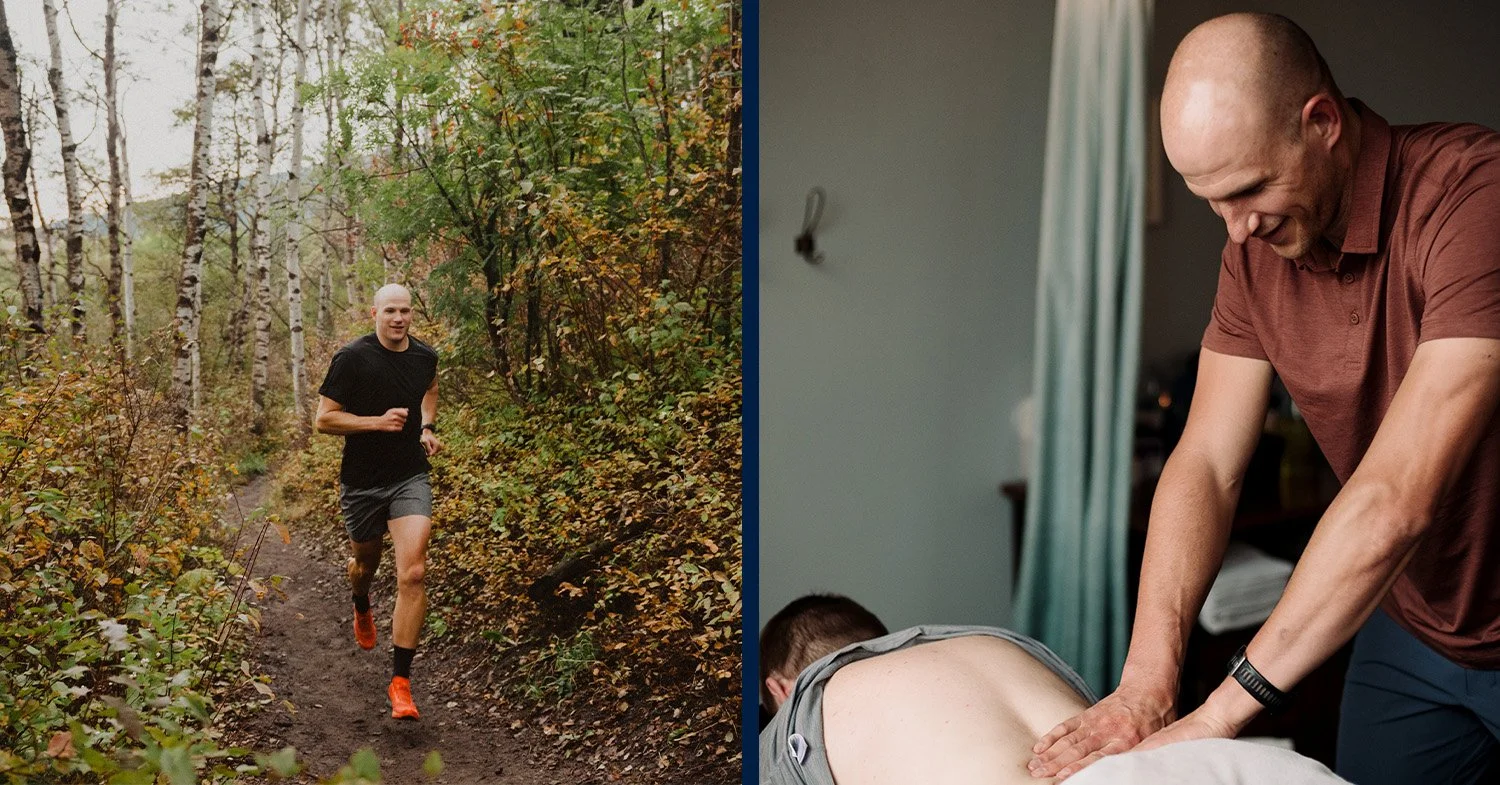
For tips on running recovery, we talked to Danny Foerster (PT, DPT, USAT L1), a physical therapist and coach in Bozeman who specializes in endurance athletes. Danny played Division 1 college soccer before moving into marathons, cycling, and Ironman racing over the last 10 to 12 years, and he's been running ultras for about eight years. His interest in endurance sports started in PT school and led to a focus on running rehab, biomechanics, and treating endurance-related injuries. In other words, he's both studied this and lived it.
His overarching message is simple: do the basics really well. "Don't get hung up on all the fancy stuff," he said. These five tips are where to start.
Training for your first big adventure? Find your next race on the Destination Trail race calendar.
1. Eat and Sleep: The Foundation of Running Recovery
Ask Danny what the ideal 24 hours after a long run looks like, and the answer is almost suspiciously basic. "It's eating and sleeping," he said. "It's as simple as that, and it's as low-cost as that. You don't need the big fancy recovery boots and the ice baths and things like that."
The reason comes down to physiology. Your long run is the stimulus, the signal that tells your body to build more mitochondria, increase plasma volume, and make all the adaptations that turn training into fitness. But the signal alone isn't enough.
"If you don't fuel yourself after that training session, well then your body can't make those adaptations," Danny explained.
Sleep does the same quiet work. Especially in the deep, slow-wave stages, your body releases the growth hormone that drives tissue repair and muscle rebuilding, restocks the glycogen you torched on the trail, and lets your nervous system reset after hours of pounding. It's the shift where the day's damage actually gets repaired. Skimp on it and you blunt the very adaptations your long run worked so hard to set up.
Together, fueling afterward and sleeping are, in his words, "probably the two most important things." Everything else is a bonus.

2. Refuel Right Away, Then Keep Eating
The window right after a long run matters, even when your stomach isn't thrilled about it. Danny's approach is to start small and build. "[Have] something for some quick calories," he said, "some sort of recovery shake or some sort of snack. You want to get in a little bit of fat, protein, and carbohydrate within the first say 30 minutes to an hour." Then, within the next hour or two, follow it with a bigger, more substantial meal built around whole foods, vegetables, healthy fats, and good protein.
This is also where running recovery supplements earn their keep. A protein shake, chocolate milk, or an electrolyte mix isn't magic, and it isn't a substitute for real food. However, it's convenient: an easy way to hit that post-run window when your stomach is too queasy for a full meal. Danny's own go-to is unfussy by design: "Either a protein shake or a chocolate milk and maybe an apple or an Uncrustable." If a shake gets fat, protein, and carbs into you faster than firing up the stove, that's a win. Just don't let the powder cabinet distract you from the meal that should follow it.
Here's the part most people get wrong: they stop eating too soon. After six, seven, or eight hours of running, your metabolism is spun up and stays elevated for a while. "You might feel like a bottomless pit," Danny said. "You might eat a meal and then a couple hours later you're like, I need to eat an entire meal again."
That's your body asking for fuel! After a big session or a race, it's fine to eat more than you would on a normal training day, and yes, "it's okay to have that extra scoop of ice cream." Underfueling, Danny notes, is the single most common recovery mistake he sees, so when in doubt, keep a steady drip of nutrients coming.

3. Move a Little, But Don't Turn Recovery Into a Second Workout
Total couch lockdown isn't the goal, and most of us couldn't manage it anyway. Some gentle movement the day after a long run helps. "Some sort of active recovery is generally pretty good just to kind of help flush the body," Danny said. "It helps loosen you up and break up some of that stiffness." Active recovery could include a 30- to 60-minute walk, an easy spin on the bike, or a light jog.
Danny sees runners finish a Saturday long run, declare Sunday a rest day, and then spend seven hours doing yard work in the sun. "That's not necessarily recovery," he said. "You're trying to thread that needle of being sedentary on the couch and spending all day doing low-level activity."
Aim for easy movement, then genuine rest. A walk and a foam-rolling session beat a full day of errands disguised as a day off.

4. Spend Your Money on the Right Running Recovery Tools
There's no shortage of running recovery tools competing for your money, and Danny's guidance is to start at the low-tech, low-cost end of the shelf. "The lower tech and the lower energy [tools are] going to be better," he advised. Foam rollers top his list as the most effective option for the least money. Massage guns earn a spot too, especially if it means you'll actually do a little soft-tissue work from the couch instead of skipping it. And a pair of compression socks or tights is worth having, particularly for long runs and travel to a race, where they help keep your legs from swelling up.
What about the high-dollar end, the recovery boots and ice baths? They feel great, Danny admitted, but part of that's simply that you've been lying still for an hour.
Ice baths come with a catch: used after every session, they can actually work against you. The inflammation from a hard run is part of the signal your body uses to adapt, "and so if you did an ice bath after every session, you're kind of dumbing down that feedback to your system." Save the cold plunge for after a monster day or a race.

5. Don't Underestimate Social Recovery
This tip rarely makes the common lists, and it might be the most underrated of all. "There is a huge psychological benefit to social recovery," Danny said. The scene is familiar to anyone who runs with friends: you finish a long day, you stand around the trailhead with a chocolate milk, and you spend half an hour talking about the climb that wrecked you or the downhill where you nearly ate it.
That hangout does real work. Will a post-run chat lower your inflammation? Not directly. But venting and laughing shifts you "out of this high function, sympathetically-driven nervous system" and into the parasympathetic, rest-and-digest state where recovery happens. You stop performing and start chilling.
As Danny put it, if there's a creek nearby, go sit in it for 10 minutes. "There's your ice bath. There's your social recovery. And you have a chocolate milk." Calories, cold therapy, and good company in one stop. (Keep the beer to a minimum, though. Alcohol works against recovery.)
The Thread Tying It All Together: Consistency
If there's one idea underneath all five tips, it's this: "Figure out what works for you and then don't change it." Once you've found the recovery shake, the meal rotation, the sleep routine that works, the hard part is over. Now you just repeat it.
"No Olympian said, ‘Oh yeah, I just did whatever I felt like that day,’" Danny said. "They are structured, habitual, rigorous people, and that over long periods of time is what builds success." Find your systems, then execute them religiously.
None of this requires a lab, a sponsor, or a closet full of gadgets. It requires basic foods, a nap, a walk, and a couple of friends. Do those well, week after week, and your body will be ready for whatever you sign up for next.
Ready to put all that recovery to use? Browse the Destination Trail race lineup and find the one that's calling your name.
This article features insights from Danny Foerster, PT, DPT, of Physical Therapy Elite. It is intended for general education and is not medical advice.