
How Becca Rick Advanced Women’s Fuel Research and Won the Moab 240 (At the Same Time)

Summary
Becca Rick is a registered dietitian and the top female finisher of the 2025 Moab 240. During the race, she collected research data on herself to help fill a near-empty field: how women fuel, expend energy, and recover across multi-day ultramarathons. Her case study is one of the first to track a female runner's intake and expenditure over 240 miles and the four days that follow.
Running 240 miles through the canyons and slickrock around Moab is already an unusual way to spend a week, but Becca Rick decided to make it a science experiment, too.
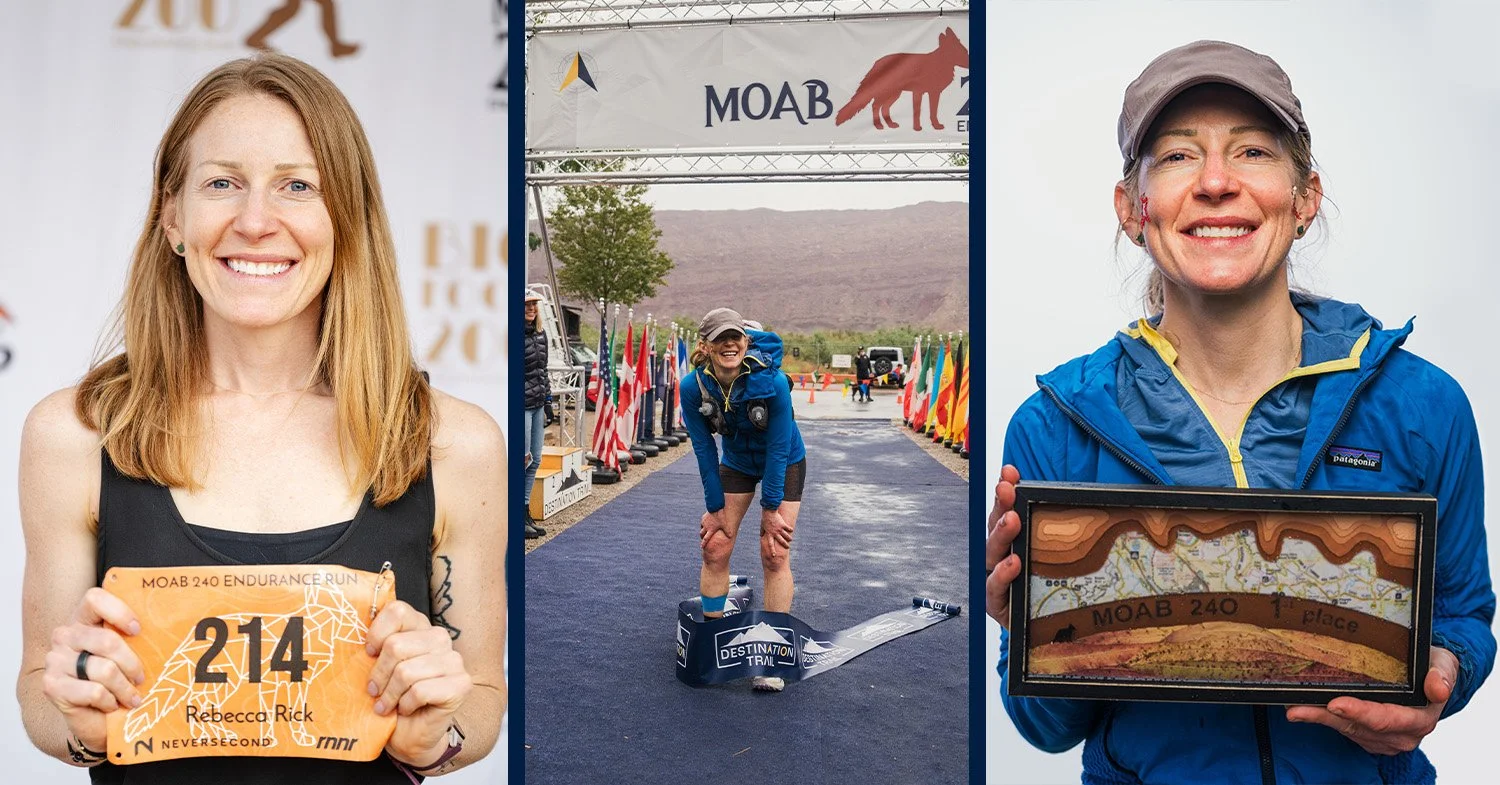
Becca is a registered dietitian, intuitive eating counselor, and board-certified sports dietitian (CSSD). She's an assistant professor and Director of Sport Nutrition Education at the University of Utah's College of Health, and the top female finisher of the 2025 Moab 240. She also runs a consulting practice for endurance athletes.
When she lined up at the start, she wasn't only chasing a finish. She was gathering the kind of data almost no one has on women in multi-day racing. We sat down with Becca to hear what the experience taught her, what the numbers revealed, and where the science is headed next.
Ready to test your limits? Check out the Destination Trail race calendar for the full lineup of 200-milers and beyond.

A Field With Almost No Data (Especially for Women)
Endurance nutrition research has a glaring hole, and it gets wider the longer the race. When Becca went looking for prior studies on multi-day ultras, she found very little. By her count, only about eight participants had ever been captured in similar research, and just one was female. That single study didn't even measure what the woman ate during her race.
So the most useful thing she could do was add to the record, even if it cost her time. Her crew questioned whether the data collection was worth the lost minutes at aid stations, but she decided it was. As she explained, "The tricky part of field research is getting participants to take the time to participate." The science only moves when runners are willing to give up part of their race for it, and she wanted to contribute.
The goal: To better understand how women fuel, expend energy, and recover across multi-day ultramarathons.
Turning a 240-Miler Into a Study
With help from colleagues at the U, Becca was connected to Andy Creer’s research group in Exercise Science out of Utah Valley University. To measure how much energy she actually burned, they used doubly labeled water, known as the "gold standard" for total energy expenditure and a method usually confined to the lab because it's expensive to run. She drank a small solution of labeled isotopes, then collected urine samples at the race start, finish, and every 24 hours after, up to 96 hours after finishing. She then mailed them to a lab to analyze her burn rate.
Tracking intake was messier. You can't exactly weigh a burger at mile 100. A sports-dietitian friend on her crew measured everything she ate at crew stops. Between aid stations, Becca recorded voice notes and photographed her food, later feeding it into nutrition analysis software to estimate intake.
The team weighed her on the same scale throughout, accounting for clothes and shoes. She also ran a 25-symptom GI questionnaire every time she reached crew, scoring nausea, bloating, hand swelling, and the rest.
That last part wore on her. "For me, it was mostly a welcome distraction," she says of the research. But answering 25 gut questions deep into a 240-miler, when she'd rather be dealing with her feet or taking a nap, was the exception. She knew it would get irritating, and "it certainly did."
And yet even with the tedious weigh-ins and questionnaires, Becca managed to be the top female finisher and fifth overall at the Moab 240, finishing in just over 72 hours.
What the Numbers Showed
During the race, Becca took in about 60% of the calories she burned. That's a deficit, which is expected, but a smaller one than most comparable studies, where intake usually lands between 40 and 50% of expenditure. "60% is high," she noted, crediting the nature of multi-day events: lower effort, longer duration, and a lot more time to eat. As she puts it, "I stopped a lot, and I was eating a lot."
That higher intake points to a question Becca is keen to chase down: "Would you see a performance benefit if you close the gap even further?" For now, she's candid about the limits of a single case study: "We don't know that."
The recovery data was just as telling. In the four days after she finished, her resting energy expenditure roughly doubled compared to her pre-race baseline, a measure of how hard the body works to repair itself while seemingly doing nothing. Her intake climbed even higher, which was the natural push to claw back the deficit.
Then there was the weight. In shorter races, runners almost always lose weight and fight dehydration. Becca saw the opposite. Her fluid turnover ran just over 10 liters a day against an intake of around nine, yet her weight kept creeping up: more than 8% above baseline by the finish, then peaking above 15% between 48 and 72 hours into recovery. "I had roughly 18 to 20 pounds of excess weight on me that was clearly fluid," she says. She points to inflammation and tissue damage and flags them as prime questions for future research.
She presented the case study at the 2026 American College of Sports Medicine (ACSM) conference, sharing a poster that charts intake versus expenditure, macronutrient breakdown, and body mass changes across the race and recovery.

Part of a Bigger Movement
Becca’s case study is one data point in a field that's finally drawing attention, and she points to two efforts leading the way.
Stanford's FASTR program, short for Female Athlete Science and Translational Research, works to close the gender gap in sports science, focusing on energy availability, the risks of low energy availability, and downstream effects such as bone injury. The program also translates its research into practical guidance for athletes and coaches, and has run collaborative projects at Western States.
Then there's lululemon's FURTHER project, the brand's first women's ultramarathon. In March 2024, 10 female athletes ran a six-day race on a looped course at Lake Cahuilla in California while researchers tracked bone health, blood markers, and more, with some runners covering 300 to 400 miles. The initiative was built to close the sex and gender data gap in sports science, addressing questions such as whether women exhibit superior fatigue resistance during multi-day efforts. (FastTalk Labs has a thorough breakdown of what FURTHER is teaching us about fueling, recovery, and performance.)
Closer to home, Becca expects to be a subject in an extensive study at the Wasatch 100 this fall, which plans to take muscle biopsies to measure glycogen stores before and after the race. Each project chips away at the same problem: women are winning these races, but the science is still far behind.
Where to Follow Becca Next
You can follow Becca’s consulting work at Nutrition Mechanic and The Gait Lab, and keep up with her racing on Instagram @becs_slc.
The takeaway from Becca’s research is simpler than any single data point: every runner who volunteers for a study (and every race that makes room for one) helps build the knowledge the sport has been missing.
Curious which 200-miler might become your own proving ground? Compare the Destination Trail races and find the one calling your name.